not yet it isn’t

BLACK FRIDAY IS HERE declares a post about a plugin sale.

No. It’s the Wednesday before Thanksgiving. Give things their own time.

The last couple of years have seen the rise of “Black Friday Week” — which makes as much sense as “No-Shave November Year” — followed by several days of “Cyber Monday”, only one or two of which are actually on a Monday. Though of course, the first signs of “Black Friday” begin on about November 1.

This is part of a general temporal smearing of the holidays though. The pumpkin spice frenzy began in August. My mom — a big fan of Christmas — wanted me to have a wishlist ready in September. Stores started selling Christmas decor before Halloween.

I like the holidays generally, but they all have their specific times. Stretching them out to cover 1/4 of the year dilutes them and can make us kind of tired of them before they’ve even happened.

And of course Black Friday seems as if it’s taken over as the second most important “holiday” of the year. I appreciate getting some online deals on things — music software is especially discounted for two or three weeks, even though it’s not something that is frequently gifted — but it kind of indicates where our minds are at as a society.

it’s electric

So there’s finally going to be a new Half-Life game

…and it’s apparently VR-only.


I’m reading a slightly tedious book about the more or less simultaneous rise of popular interest in science and fairy tales in Victorian England, and how they influenced each other and the literature of the time. It mentions L. Frank Baum’s The Master Key: An Electrical Fairy Tale — the story of the wish-granting Demon of Electricity summoned accidentally by a boy’s scientific experiments — and it occurred to me “An Electrical Fairy Tale” might be a fun name for the next album. Because, if what I’ve recorded so far is any indication, it really is that different from the darker stuff I’ve been doing lately…

There’s apparently a yearly music festival called “Electric FAIRy Tale” in Fresno, but I don’t think I’m going to let that stop me. I may come up with a name I like better anyway, though.


The Sequential DSM03 Feedback module that I won in the charity auction arrived yesterday. It’s basically a Karplus-Strong synthesizer in a single module: a white noise generator with built-in envelope generator, a short delay with 1V/octave tracking, and a lowpass filter; there’s an external audio input which you can use instead of its own noise generator. It’s got a couple of issues though — I don’t think the feedback is strong enough for all circumstances, and adding filter resonance tends to suppress the feedback and make it very quiet. It’s capable of some interesting sounds regardless. I’ll pledge to keep it in my rack at least until the E520 comes along.

plug it in

I have written a lot in this blog about music hardware, but not nearly as much about the software that is also a vital part of my sound. Maybe it’s time. I won’t go into Bitwig’s built-in effects, nor the occasional synth plugins, but here are the third-party effects plugins that I use on a relatively regular basis.


Delay: super important to me, adding space, movement, character, rhythm and of course just plain echoes.

  • Valhalla Delay: for me this is the top of the heap for sure. A perfect combination of simplicity, flexibility and character, and it keeps getting better (there are three new variations in the current beta and they’re all fantastic).
  • Arturia 3 Delays You’ll Actually Use: some nice character here, particularly when overdriven and using their parametric EQ. Second fiddle to Valhalla, but it’s nice to have alternatives.
  • u-he Colour Copy: largely superseded by Valhalla, but for liquid, chorusy modulated delays it has a special lushness.
  • Audio Damage Ratshack Reverb: while I can probably get a similar sound with Valhalla, it’s just right there on tap. And the distortion it offers is pretty special.
  • Sonic Charge Permut8: when what I want isn’t a delay so much as a glitchy repeating weirdness thing, this is where I go.

Reverb: for making space and distance, smoothing out textures, as a medium to apply other effects in a feedback loop, or sometimes extending the duration of tails that I faded too quickly.

  • Valhalla Plate, Room and Vintage Verb: All excellent, though Plate is my favorite.
  • u-he Twangström: a fine emulation of spring reverb, when that kind of character is called for. I sold my real spring reverb because of this plugin.
  • AudioThing Fog Convolver: for applying real acoustic spaces, including some weird ones. I usually keep this one subtle, but I’ve found building a feedback loop around it can be fun too.

EQ: the scissors to generally shape my sounds and the scalpel to cut out problem areas. My music doesn’t tend to have the same kind of mixing applications for EQ that more mainstream music does, but this is still pretty vital.

  • Toneboosters Equalizer 4: My go-to general purpose and corrective EQ, whether full stereo or mid-side. It’s frankly unbeatable.
  • u-he Uhbiq-Q: I keep finding myself turning to this one for character, and for “blind” EQing where I want to trust my ears without graphical assistance.
  • Honorable mention: I just picked up McDSP 6050 and am learning it; among other things, it has 12 different analog-style EQ models with relatively subtle differences between them. There might be a favorite character EQ lurking here too.

Limiters: for keeping peak levels in check and feedback loops from exploding, and increasing loudness as the last stage in mastering.

  • Toneboosters Barricade 4: combines a saturator, compressor and limiter, but I use it primarily for limiting — its saturation can often get ugly and I find it very situational. I could probably just use Bitwig’s peak limiter instead, honestly.
  • u-he Presswerk: it’s a big fancy compressor plugin, but lately I’ve been using it almost exclusively for one of its limiter presets that can be pushed hard and does some nice soft clipping. The exact peak can’t be set, so I often use it as my first limiting stage before Barricade.

Compressors: I’m still trying to work out favorites here; this is an area I have long neglected in favor of the Graphic Dynamics tool in Sound Forge Pro.

  • NI Solid Bus Comp: I feel like it works well for subtle compression, and is fairly easy to dial in.
  • Klanghelm MJUC: a vari-mu tube compressor emulation, with a little more flavor than Solid Bus Comp but not over the top. For mastering purposes I’ve frequently found myself trying both of them and choosing my favorite (usually but not always MJUC).
  • NI Supercharger GT: To me this is best for more aggressive saturation and compression, but works nicely when mixed in parallel at a low level.
  • Honorable mentions: Graphic Dynamics still does have its uses. I used to try a couple of favorite Presswerk presets and A-B test them to see if they improved the overall clarity — and I should probably try its simplified modes against other options. McDSP 6050 has several analog style compressor models to choose from and seems promising. But I may find myself with FabFilter Pro-C2, since it’s very visual like my favorite EQ.

Tape: recording to tape is like acid-washing jeans — it adds character and/or grunge and it’s a good thing. In a plugin, you can control the variables with less hassle, expense and time than real tape.

  • Wavesfactory Cassette: this is a relative newcomer. It’s great for a touch of saturation and subtle compression, or heavy blown-out saturation, or extreme “4th generation copy using a warbly microcasette recorder and worn-out tape” effects.
  • XLNAudio RC-20 Retro Color: this one does vinyl, sampling and tape, with particularly tasty distortion and EQ sections. It’s really flexible and can do very non-tapelike things, and again works well both for gentle and extreme use.
  • Denise Bad Tape: a very up-front effect, with heavy and weird saturation. Sometimes useful though!

Downsampling: for retro digital sound, or just another flavor of dirt.

  • d16 Decimort: a pretty flexible sample rate and bit reducer with some anti-aliasing options, jitter and EQ.
  • Plogue Chipcrusher: realistic bad old digital encoding methods, with added noise and filter/speaker/cabinet impulses to sound like it’s coming from an old PC or game console or handheld toy.

Utilities:

  • haSound MSLR: mid/side left/right encoding and decoding. I use it pretty frequently with two different signals from the modular to create a wide stereo field. Needs some caution to prevent phase alignment issues though, and I may switch back to Voxengo MSED for its built-in scope.
  • Izotope RX6 DeClick: doesn’t work on 100% of clicks and pops, but when it does, it “just works” with no hassle or side effects.
  • Klevgrand Brusfri: a real-time noise reduction plugin that can listen to an example of your noise floor, and then dampen it pretty effectively.
  • Melda MAGC: automatically compensates for volume differences caused by an effect, which can help remove the illusion that louder=better, or confirm that a compressor’s make-up gain is set wisely.

Metering/Visualization:

  • Voxengo SPAN: an excellent spectrum analyzer with a phase correlation meter.
  • Voxengo Correlometer: a multiband phase correlation meter that can show which frequency ranges have problems. It makes fixing those areas with mid/side EQ a bit easier.
  • Youlean Loudness Meter: shows real-time true peak and LUFS readings, and can synchronize its display with the host’s transport time.
  • Honorable mention: the Statistics tool in Sound Forge Pro. Much faster than Youlean, but it measures what has already been done to the file.

Weird stuff:

  • Unfiltered Audio SpecOps: various kinds of spectral filtering, mangling, and freezing. There’s a lot going on here. It could be dethroned by the SynthTech E520 when that ships, though.
  • Melda MTransformer: I find this pretty interesting mostly for spectral compression or formant shifting. Again, the E520 might bury it.
  • Melda MCharacter: it attempts to synthesize extra harmonics, and/or spectrally filter the input, but it’s kind of touchy and situational.

Have any favorite effects plugins, or recommendations especially for dynamics? Let me know!

not an exact science

The idea of inheriting ethnicity through DNA is a bit problematic:

  • Biology and culture are different things. Culture is not passed genetically.
  • Genes are randomly inherited in each generation. The more generations back you go, the more random it is.
  • There is no single “French gene” that you might have 36% of. Either you carry a gene or you don’t, and all of this stuff comes down to statistical analysis from data that comes from peoples’ family histories.

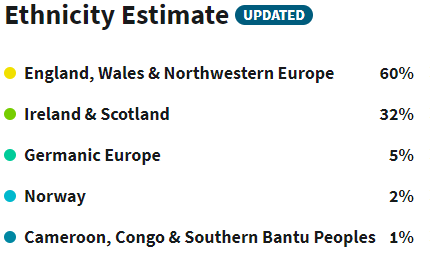
So I think of this as mostly “for entertainment purposes only.” That said, here’s what Ancestry.com says about me after the latest statistical update:

It’s a slight tweak from the reading a few years ago, but no big surprises. Looking at the family tree research my mom has done, as far back as is documented right now, it adds up. There’s a very clear “all Scotland all the time” going back from my mother’s father’s mother, but most branches on both sides of my family, if they don’t fade into obscurity in Kentucky or New York, point at England, Ireland, Scotland, and some Germany and Switzerland. It would be really cool to be able to trace DNA to specific relatives on the family tree, but I don’t think things work that way, even if they all had samples.

nobody needs a billion dollars

An excellent twitter thread from author Seanan McGuire.

Quoted in full:

People keep talking about how much stuff a billionaire could buy even after Warren’s wealth tax, as if that were the greatest horror of that number. “Tax the rich and they can still buy islands!” Yes, that’s horrifying. But my friends and I have been calculating the “okay, that’s it, I’m done” number for years. That’s the amount of money in the bank where you can live deliciously without ever touching the principle. 

Everything is done via the interest. Our numbers assume no investments, no money management; just a savings account with a decent interest rate, calculated monthly. 

If you could open a savings account with a 2.05% interest rate and a starting balance of one million dollars right now, today, you would make 20k a year, just for the effort of having all that money. 

At five million dollars in the bank, you’re making 100k a year for doing NOTHING. Almost anywhere in the country, that’s living-off-the-interest time. (SF Bay Area and New York, somewhat excepted.) 

Six million in the bank, you’re making 120k a year for doing nothing. That’s 10k a month to spend on bills and vacations and IDK, new live ponies for Kaitlyn and Hunter. 

But ten million is where we start hitting real money. Because with just ten million–JUST ten million, and remember, we started with BILLIONaires–you’re seeing 200k a year for doing nothing other than NOT funding a mad genetics lab to create dinosaurs for your amusement. 

At fifty million, again with our simple savings account, no investments, you’re making a million dollars a year by not touching your principle. A hundred million is two million dollars a year.

A billion dollars is a thousand millions. 

This is wealth on a scale that has no applications apart from supervillainy. I am GOOD at spending money. Give me a hundred million dollars and I’ll make dinosaurs.

A thousand million dollars? I’ll make frantic noises and hide under the bed. That is money turned monster. 

No one NEEDS a billion dollars. Ten million is enough to live so comfortably that you’re insulated from the world forever. And no one NEEDS that, either. 

If a hundred million dollars is two million a year in interest, then a billion dollars in that rock-bottom account is two hundred million a year. Just for owning money. 

That last bit is off by a factor of 10, but the point still stands. To me, $10 million sounds like a good amount to keep after winning Powerball, after taxes, debts and giving the rest to family, friends, charities and random strangers.

Bill Gates is currently worth $107 billion. Which means his hypothetical 2% interest would earn $2.1 billion a year for doing nothing, not even wise investing. Every year he could turn two paupers into supervillain-level rich people, or 210 completely broke families Powerball-level, never-work-again wealthy, with zero personal sacrifice to his own astronomical fortune.

This makes me think Elizabeth Warren’s 3% wealth tax on billionaires is just barely a start.

the moon is beautiful this morning

It may still be stupidly cold, and I may still have the remnants of a cold, and somebody may have either mistaken the phone charger at my desk for company property or just “perma-borrowed” it… but the sky gave me a gift on my morning commute.

I tried to take a photo. It didn’t save, and it wouldn’t have been very good if it did — sky photos on a phone, taken hurriedly through the windshield during a brief traffic light, are never very good.

So, picture a pinkish-blue streaky sky and an enormous full moon in clear detail, with a hint of a glowing corona, about 30 degrees above the horizon. You’re probably right now picturing something that looks a little too plain, a little too “realistic”. Make it more vibrant and intense and painterly… borderline unbelievable. Stunning. Yeah, that’s better. Now put the back of a garbage truck below it, because as magical as it was, it was still in the real world (and that somehow made it better).

By the time I got to work and had time to set up a better photo, the sky had changed; the moon was neither so clear nor was the “background” sky (the atmosphere in front of it!) quite as nice. All things are ephemeral.

It filled me with such wonder though, like too few things do in a sane, stable-ish adulthood. And now I have the desire to try to express that in music. Next album project, perhaps? It seems like a challenge, but a good one.

Back when I used to play the text-based MMORPG GemStone III (and then IV), I had a character who was devoted to Zelia, the goddess of lunacy. While it wasn’t in the sparse official documentation at the time, some players seemed to tacitly agree that Zelia’s good side, her gift to her followers, was a gleeful, childlike sense of wonder about random things — an openness that is lost to most adults. Years after I’d stopped playing, when one of the lore documents named the six Handmaidens of Zelia (a constellation), one of them was “Myzori, the Most Amazed.” The idea of amazement as a kind of virtue, something to seek out, and a form of devotion stuck with me. (I of course would like the occasional amazement and silly good fun without emotional instability or delusions…)

small bits

Sunday it was a lovely 65°F throughout the evening. Monday at that same time, it was 25 and windy and been snowing most of the day. This morning as I’m about to go to work, it’s

which is just too flipping cold. Autumn is my favorite season, but for the last few years, it’s seemed like it was under attack from both sides. Going from picnic weather to parka weather in one day is just too much.

Anyway. Here’s a thing I did, a quick jam on the Lyra-8 with another layer of distortion, inspired by the computer game I’ve been playing quite a bit of lately:

Noita (Finnish for “witch” or “shaman” apparently) is the sort of game where, if I am bad at it, it’s kind of hard to tell because so much of it comes down to random luck, impossible situations, and occasionally completely unfair events. Yet usually the most ridiculous sudden deaths even after a long, careful campaign are more entertaining than frustrating. You’re a levitating wizard with a couple of basic wands to start with, on a dungeon crawl through increasingly deadly environs. Everything is physically modeled like a “falling sand” game — water flows somewhat realistically, evaporates when heated and condenses again; wood and coal and oil burn at different rates; fire needs oxygen; oil is slippery and floats on water; slime is sticky; sandstone is softer than other rocks. But it also plays like a high-speed magical game of Worms. You find and tinker with more and better (and sometimes ludicrously dangerous) wands and potions as you go: tentacles, arrows, bouncing bolts, chainsaws or flying sawblades (!), lightsabers (!!), freezing, acid balls, lightning, boulder summoning, lakes of lava, Giga Death Crosses, nukes (!!!!!)

Theoretically, there’s a way to “win” the game. I’ve never seen it. I’m lucky to get through the reach the incredibly deadly jungle level with its robotic spiders and fire-flinging flowers, or the Vault with shielded flying drones and acid-spitting floating eyes. Once I reached a place called the Temple of the Art, and got cornered in a pool of acid that was on fire while being pummeled by spells from four different completely unfamiliar monsters.

The game is full of surprises and secrets. Sometimes you do things to “anger the gods” — or a pesky earth-devouring worm does and you get the blame — and they send a flying, shielded skeleton mage to murder you. Sometimes you find mysterious secret tablets or orbs or areas of total darkness or stranger-than-normal alchemy or other weirdness. Once I drank from a “Touch of Midas” potion that turned loose substances (sand, coal, etc.) into gold when I approached; I racked up a lot of wealth but didn’t survive to spend it. Just once, I saw this in the Hiisi Base:

That’s my wizard’s blood there, because there were about five more of these guys on the other side of the screen. Oops.

done

Despite really annoying cold symptoms that have kept me home from work, partially in bed and partially half-dozing in the recliner, I’ve finished mastering the rest of the tracks — and recorded one more short one, because I felt like something with a particular character was called for.

The process mostly got easier as I went. There’s a sort of iterative logic to it that is fairly similar from one track to the next, though specifics vary. Fixing my stereo phase faults took me hours to figure out the first time, but seconds now that I know what generally works. And I was more cautious in setting up my effects on the new track and didn’t create trouble for myself in the first place.

There’s one note I have to check into with fresh ears; other than that I’m just waiting on cover art and need to write up some text. And then on to the next project!

Other than that, I’ve been reading a lot and TRYING to sleep.

I finished Last Dance, a novel about an Earth-to-Mars transport ship, its ornery captain and his rebellion. Pretty good!

I read a couple of short books on mixing and mastering, which were not awful but less helpful than the advice and practical knowledge I’d already gained. Meh.

I also read You Look Like a Thing and I Love You, Janelle Shae’s (of AI Weirdness) humor/non-fiction book on the current and likely future state of AI. She says “the danger of AI is not that it’s smart, but that it’s not smart enough” and that certainly seems true. It feels like there have been amazing breakthroughs in machine learning in the past few years, but they’re all extremely narrow in scope, easily fooled, have no sense of value judgement other than what they’re programmed to seek or avoid, are highly susceptible to bias and extraneous information in training data, tend to have very small memories, it can be difficult to understand why they made their specific decisions, and approximately as smart as a worm. On the other hand, there are some problems they can solve… as long as a human verifies them.

yes, master

I spent much of my weekend mastering four tracks from Vultur Cadens. Just as important as the specific things I learned: I’m more invested in the result, and have the goal of making my own mastering as consistent as possible with that of an experienced professional. It’s a challenge, but I’m very happy with the results I’m getting so far.

Nathan Moody was a guest recently at the Velocity synth gathering in Seattle, and gave a talk on “Mixing Modular Music” — which includes and complements the advice he gave me about my mixes.

Trying not to make this too long and technical, here are the things I’ve learned that I’m applying now:

  • It’s important when using a spectrum analyzer to set the block size high to detect infrasonic content that needs filtering out. Voxengo Span at a block size of 8192, and minimum frequency of 5 Hz, will do the job.
  • Stereo phase correlation matters even if you’re not cutting vinyl. Voxengo Span and Correlometer are easy to read: 0 to +1 is good, anything more than brief dips below 0 is bad. Toneboosters EQ4 is an excellent mid-side EQ that can correct it — after a few hours of struggle I’ve found a set of techniques that not only fixes these issues, but often results in a better sounding stereo field. I don’t necessarily care about “natural” here and I’m not aligning multiple microphones, so what I’m learning for myself doesn’t necessarily apply to every mix.
  • Fixing big resonances. Something that makes some synth sounds harsh and strident (with both the Lyra and with feedback-based synthesis), and leads to listener fatigue, is frequencies that are really loud compared to the rest of the spectrum. Often bringing them down just a little bit makes them sound great — and then subsequent compression and limiting might mean having to shave them again. Again, EQ4 is great for targeting these. For my purposes, finding these manually and fixing them once they’re already recorded is fine.
  • Compression: this can be complex, subtle and subjective. I’m just loosely imitating what Nathan Moody said he did, mostly with Klanghelm MJUC or NI Solid Bus Comp so far, tweaking until I feel like it’s doing something positive. If I were mixing a rock band or making techno or hip-hop there might be more of a system to it. I still feel I have a lot more to learn here.
  • With limiting, I still rely on Toneboosters Barricade and Bitwig’s peak limiter for ease of use, transparency and simplicity. But I have a new favorite preset as a starting point in Presswerk.
  • In terms of other flavor/vibe/etc. I find I really like u-he Uhbik-Q for flavor EQ. For saturation though, I am still very much “try things at random to see what works, if anything.” Another area where I want to learn more — I hope to someday find a favorite secret sauce, and/or recognize what to use without needing as much experimentation every time.
  • Overall I find myself bouncing between Bitwig Studio and Sound Forge Pro 13 for mastering. The former is better for chains of plugins — the effects and the analyzers to monitor them, or EQ that wants tweaking because I tweaked a compressor. The latter has a few handy tools (dynamics statistics, some noise/crackle removal options, and easy fade in/out and crossfading of effects).

busy busy

So many things just happened in the 4 hours or so since getting back from work:

  • Listened to the second round of masters back from Obsidian Sound. Perfect! There was really just a small tweak I requested from the first round (sent to me yesterday morning and answered this morning).
  • Got my Akemie’s Castle set up and started playing with it. More on this later, but I can confirm everything Mylar Melodies said in his video. Especially “what it does not sound is pristine and clean” and “super doomful.”
  • Went through the end of the “Audio Industry for Rainforests” charity auction — and won more than I expected. There was a ton of stuff donated and that meant less competition; there was also a lot less rapid-fire escalation at the very end due to the way the platform works. So I wound up with the Sequential DSM-03 Feedback module, and 3 plugins: DyVision Reverb Remover, DyVision Video Tape Emulator, and Acon Digital DeFilter.
  • Got a notification about a plugin update. Put off downloading it and then later, realized it’s not a plugin that I’m using anymore anyway.
  • Recorded a track with the Akemie’s Castle. Probably not one to be released, but it’s got some fun sounds in it, and could be an intro/outro/segue/something.
  • Also the secondhand auction ended an hour after the main auction. Since I donated stuff to that one, I watched… but the final tally is being delayed a little, so I don’t yet have to go through the license transfer process for 10 items from 3 companies.
  • Got an email from Obsidian about the processing that was done and why. Started looking up some info and interpreting that… oh yeah, I need to finished that process yet.
  • The T-Rackonizer — the last module I had up for sale — just happened to sell on Reverb at this same time. So I got it boxed up and ready to ship.
  • Started writing this post, partly as a way to make sure I’m not forgetting to do something.
  • Somehow in there I also ate dinner, fed the dogs, and supervised their outside time in the season’s first freezing weather because I didn’t want Lady escaping and giving trick-or-treating kids a real Halloween fright. (She’s a sweetheart, but she’s also a solid iron brick of pit bull.)

This — now that I believe there will be no more gear purchases in 2019 — seems as good a time as any to show my total expenditures for the year:

$11

That is the miraculous number I get from totaling all (*) of the gear I bought and sold this year. That includes the Eurorack case, all modules, pedals, and controllers, the Reface CS, and the Lyra-8. It does not include:

  • Some minor accessories and cables.
  • Shipping expenses — in retrospect I do wish I’d tracked this, because it adds up. I offer free shipping when I sell on forums, and often undercharged flat fees on Reverb.
  • New computer — I would have bought it sooner rather than later anyway.
  • Things that aren’t gear — KnobCon expenses, mastering, Distrokid, web hosting, income from album sales.

Things that I tracked separately:

  • Software. The Bitwig license, a Bitwig beginner training course, Sound Forge Pro 13 upgrade, and a handful of minor plugins. These were 3/4 paid for by selling some plugin licenses I am no longer using. The remaining licenses were donated to the secondhand charity auction, where they raised $157.
  • Preordering the SynthTech E520. My justification is, it ships in May 2020 so it goes on the 2020 budget. 😉

Okay, so it’s really more than $11. But my goal for the year wasn’t a $0 budget, it was to track my spending to stay mindful of it.

From this point, on my guiding principle is “the gear I have is excellent, complete and satisfying.” There may be a hard budget limit or a maximum number of transactions or something, but I may just trust the principle instead.