
My almost-no-new-gear pledge has been going great, and I haven’t been tempted by any new or old hardware or software… until now.
Yesterday, I had the thought that Walk 4, and to a lesser extent Nibbler and Clep Diaz, might benefit from a clock multiplier. Each of those modules takes an incoming clock, and uses it for partial steps toward a slower whole. Walk 4 divides the frequency by several octaves (or non-octave intervals) if you want more detailed, less steppy outputs… it’d be nice to generate harmonics and subharmonics rather than sub-sub-sub-sub-sub-subharmonics.
I started thinking maybe 4ms SCM (Shuffling Clock Multiplier) would be a good candidate for my one (not preordered in 2025) module acquisition of the year. With multiple rate outputs, and CV inputs to both mess with the rhythm and to rotate the multipliers around some of the outputs, it could be a little extra fun. But I thought: first I’m going to experiment with what I have, because I know some of my modules have a limited ability to multiply clock timing…
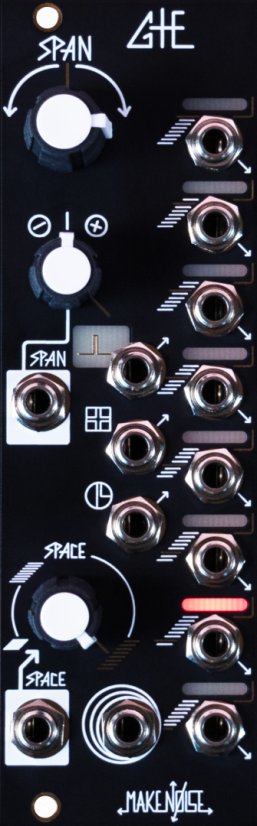
Today, Make Noise announced a new module in the NUSS line. GTE (Gestural Time Extractor, or GaTE) is an analog module that takes an input CV and switches on one of 8 gates depending on the level; it also generates a couple of extra outputs that can detect level changes, and has an optional clock input so the gates only change on a clock pulse. The Space knob changes the ranges of the 8 levels, so you can have it rapidly fire off some triggers and then go silent… lots of rhythmic control is possible. There isn’t any single prescribed usage for it, but there are a lot of possibilities. One of those happens to be clock multiplication, but only assuming your input is a linear saw or triangle wave. (Like the Triggers module in Bitwig Grid: a “phase” input is subdivided into trigger outs.) It’s also perfect for the NUSS index CVs, such as the one that Multimod generates.
(The name reminds me of the old telephone company. Apparently through a couple of steps it was absorbed into Verizon.)
The more I thought about it, the more fun I started to think this could be. Not necessarily to use with Multimod’s index output, but for all manner of other things.
I tried that clock multiplication experiment. Stages was my best bet, and it operated okay but can only multiply by 4, and only if the input frequency isn’t much more than 1KHz. Marbles had a lower maximum and seemed less stable. Mimeophon also wasn’t too good at multiplying clocks, even though it’s capable of short enough delay times to generate nice audio itself. But K-Accumulator…
Yes, it’s overkill to use a mega-flagship oscillator as a clock multiplier. But its tracking mode is adept at keeping up with audio rate input and responding a few octaves higher. And then you can do some extra tricks with the patch anyway. So I think for no more often than I would want to use multiplication, I’ll stick with that.
Giving serious thought to declaring GTE as my 2026 module though. On the one hand, maybe I should wait to make sure there isn’t something even more amazing that I will want. On the other, isn’t that just another kind of FOMO? Hmm. I really don’t need other oscillators, filters, modulation sources, controllers etc., and this is exactly the kind of interesting, multi-purpose/no-purpose experimental semi-utility module that is probably the only kind I should even be looking at.
Speaking of music, I now have about 42 minutes recorded, a plan and material to record the final track, a nice progression of track names that fits the theme, and some general ideas about artwork. If I didn’t have to sleep last night and work today I might have recorded two tracks in a single night and had it finished. But there is no rush other than a creative rush 🙂
On the diabetes front, I am not quite as liberated from insulin as I hoped I might be. What I’ve settled into is checking my blood before each meal (or before we go somewhere for dinner) and making a decision based on that number vs. what I’m probably about to eat. Sometimes my fasting or pre-meal number looks great, and if unless I’m going for something very carby, I can skip the shot. I might take less than my old dosage if things seem intermediate, or make a different decision about what to eat.
This has the side effect of keeping me more aware of what I’m eating and what it does to me. Ideally, I’d count carbs, and either use a continuous glucose monitor for a while, or measure at intervals after eating as well as before, and use a formula to determine dosage the way folks with Type 1 do. But I think this is going to work out fine.
I’ve now had my Oura ring for a month, and the first subscription payment went through. I’m actually OK with the subscription fee, though of course I’d love to not pay it and still get all the features 😉 There are minor software updates approximately weekly. While sometimes advice/insights conflict a bit, I feel like it does a pretty great job with the data it can get just by shining some lights at a small amount of skin. The sleep tracking is especially good, and is leading to better habits that have led to better sleep. The heart data it gives me has turned out to be more reassuring than not, once I got used to a few surprises. And it confirmed that yes, I absolutely was overdoing it the other day when I cut down the remaining unhealthy bit of tree in my parents’ back yard and helped break it down to put in yard waste bags.
I’ve noticed a couple of other people wearing them now that I have one. They’re a little discreet but not that discreet. My doctor was one of those people, which is kind of encouraging.