Stickybrute

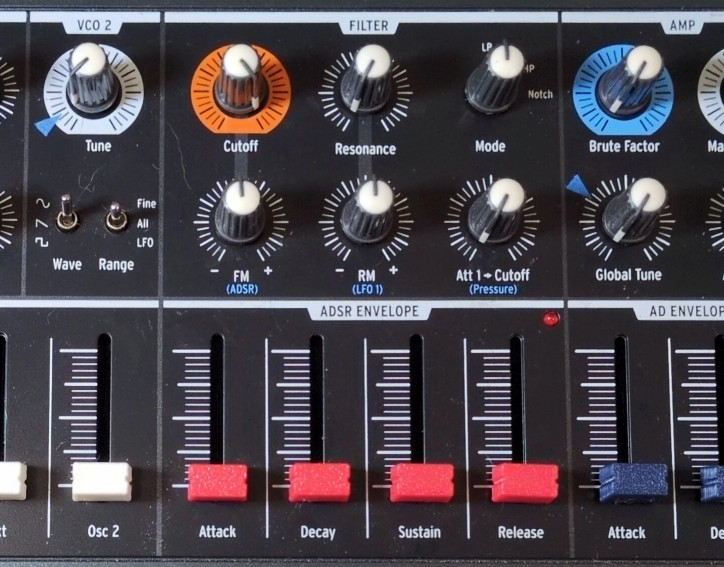
Well, it finally happened. The soft-touch knobs on my Arturia Minibrute 2S have gone sticky and gross.

This does not happen with all soft-touch knobs — or if it does, it takes many more years. I have no issues with older Make Noise or Mutable Instruments modules that use Rogan soft-touch, nor any others that I can think of. But whatever Arturia is using definitely degrades to a sticky mess over time, according to… pretty much everyone on the internet who owns a Minibrute or Microbrute.

There are two options:

  • Scrub them down with alcohol to dissolve the rubberized stuff (this reportedly takes about 3 hours of labor, and it’s tricky to get all the stuff out of the crevices)
  • Replace them. Except of course, these knobs are unique: they use a standard D-shaft but the pointers are 90 degrees off. You’d think as common of a problem this is, somebody would have stepped up with 90-degree replacement knobs, but they have not.

Someone figured out that Magpie knobs from LoveMySwitches, plus brass inserts to convert the D-shaft to 1/4 round, work perfectly. I also suspect the Intellijel style two-part knobs from Thonk would do the trick… but it would cost me more and I like them less. So the Magpies it is.

I’m going to replace the 23 main knobs, and ignore the sequencer knobs at least for now. I just don’t use the sequencer that much. At least if I decide to swap them out, their lack of pointers means I’ll have more options.


That novel Awakened just keeps getting more awesome. The magic is very cool, the characters are all super memorable, and the Big Bad is seriously, truly frightening. It’s a fantasy novel for sure, but also a thriller. (The author’s other novel to date is not fantasy (that I know of), but is a thriller; I kind of want to read it because I like this one so much, but I kind of don’t because it’s about misogynistic gamer culture, and ugh.)


I finished the recording phase of Call & Response yesterday, and since the older 4 tracks are already mastered, I just have the newer 5 to do. If I stay focused I can release it for this upcoming Bandcamp Friday.

writing about reading

Polostan was very good. The Rise and Fall of D.O.D.O. remains my favorite Neal Stephenson book, but this might be my favorite spy novel. Nevermind that I haven’t read a lot of spy novels… this one had the same situational craziness factor that several of Stephenson’s other books did, while both being historical and not getting bogged down in excessive details. I absolutely want to read the next one because I need to know how the protagonist gets out of her situation!

Lord of the Butterflies, one of the Andrea Gibson poetry collections, was also excellent. I can now say that I’m a person who reads poetry for enjoyment. I just need more experience at it. ๐Ÿ™‚ The poems made me feel dread, grief, righteous anger, recognition, joy, triumph, whatever one calls responding to cuteness, and appreciation of skill. Wit, sarcasm, beautiful (or ugly but so real) images, clever turns of phrase, puns, clever formatting or line breaks that create the rhythm. Poetry is closer to music than I had previously suspected.

I’m inspired to write something about my own gender experience. Maybe that’s not very original of me, but I’ll still be writing from my own life and it’ll be my own creation, so it kind of is. ๐Ÿ˜›

I’ve just started reading Awakened by A.E. Osworth. Normally I have to get past the dedication page before I start loving a book, but:

And yes, the book is a subversion of Harry Potter tropes: trans characters, a magical awakening in adulthood, a secret world of wizards that does NOT have any schools or inherited vaults full of gold or Chosen One destinies, and no wise Dumbledore but rather someone who tries to help the protagonist adjust and fucks it up. That’s the first chapter. And might I say, much cleverer use of language and more engaging and dynamic dialogue than cartoon villain Joanne.


One of the poetry books I ordered through Alibris didn’t show up. The seller instead shipped me a 3-pound hardcover book ordered on Amazon.de by someone in the Czech Republic. It seems potentially interesting and I wouldn’t mind reading it, but I did what I thought was the right thing and contacted the seller. They said to return it via the Alibris website. So I started that process and… they won’t actually cover my return shipping fee, just a $5 expires-same-day store credit. Shipping (for me, without a business that could ship it as Bound Printed Matter) would be over $23. This is not going to happen. I wrote the seller again to see if they can send me a printable return shipping label, but haven’t heard anything back. If I continue not to… I guess it’s my book. I don’t want to rip anyone off, especially not an independent bookseller, but I also am not going to get stuck with the absurd shipping fee to fix their goof. (Oddly, the price of the book itself was only a little more than the small poetry book I actually ordered.)

Dolly (and now Tim)

I’m going to join the wave of people praising Dolly Parton.

I’m not generally a country music fan, but she had immense songwriting talent, a fantastic singing voice and excellent control of it, and very respectable skill at the guitar. “Jolene” is one of the most haunting songs ever due to that combination, and she wrote “I Will Always Love You” on the same day. She also had fantastic stage presence and a genuine smile and a way with words that made her super charming.

But really it was her generosity, her goodness of heart that I really want to praise. I think the real reason everybody loved Dolly is because Dolly loved everybody. She took care of people — her extended family, her community, the wider world. She had gay and trans family members and friends, and funded at least one fan’s top surgery. She supported human rights, said “of course black lives matter, do you think our white asses are the only thing that matters?”, spent her royalties from Whitney Houston investing in a Black community in Nashville, started that charity for literacy, donated millions in college scholarships, personally paid families so they could rebuild their homes in Pigeon Forge after a wildfire, and funded the Moderna COVID vaccine.

Super woke, right? But even the MAGA chuds seem to love her just as much as everyone else does. She always avoided any direct appearance of partisanship and very much talks like a serious Christian. She has said publicly that “political talk” can sink careers, especially in country music… but also I think this is just the sort of person she is. Not judgemental of anyone, even of their judgementalness. This white, blonde (with the wigs anyway), country, Christian millionaire defied the stereotypes and was consistently a genuinely good, kind person, an example for others to follow.

(Meanwhile, I can’t do it. If someone hates other people for who they are, for the circumstances of their birth or their beliefs or any other reason — and especially when there is scapegoating, insults and active measures to make their lives worse — I absolutely am going to be judgey about it. Dolly might be a saint or a bodhisattva, but I’m not.)

update: I just found out that Tim Curry also died at age 80 yesterday. Another amazing icon. This is deeply unfair.

catching up

It’s been a couple of weeks since I posted, and those have felt full. Not because there’s been a whole lot of events, or big stuff going on, just… a good sort of fullness, fulfillment maybe, the continuing glow from Wep Ronpet. I was going to write a whole religious post about how I got where I am and where that is, but… nah. It’s enough to say I have had a bit more, let’s say, illumination recently and am really feeling the love.

Call & Response (the name of the next album) is moving along. Of course the fact that I started it already half finished helps. ๐Ÿ˜‰ So far, I have created my answers to a cat, a tree, and an antique (though not ancient) alien; there’s still a robot and an entire civilization yet to reply to.

I’ve been keeping up with reading, though not posting about it here. To catch up after Free Play:

Sarah Rees Brennan, Long Live Evil: an isekai story where a dying young woman gets the chance to take over the life of a villainess in a cheesy fantasy story. There’s a little bit of mood whiplash going on but for the most part, it’s a silly, fun story about… consequences really. And style.

Carlo Rovelli, Seven Brief Lessons on Physics: they really are brief. Honestly this was more of a review for me, since Rovelli has already covered this stuff in other works I’ve read. But it’s well-written and well-presented, and might be a good read for people who are curious about the state of our knowledge of the universe.

The Omni Book of Computers and Robots: honestly I only read this one because it was a gift. It’s a book from the days of the Apple ][ and TRS-80 — before the IBM PC or the Space Shuttle. A combination of futurism and reports on R&D, it was kind of amusing to see what the predictions and excitement were all about at the time. They wildly overestimated robots, lasers, space travel and biochips, wildly underestimated graphics, and had no clue how huge of a thing the internet and wireless communication would be (this was in the days before ARPANET even connected universities). The AI predictions were actually not bad, though the attitudes were super naive. The bit on telepresence was all “people want to control robot bodies!” and what we got was Zoom. There was even a chapter on synthesizers, which made it pretty clear that the author didn’t know much about it and nobody knew an explosion in digital audio was coming soon.

Amal El-Mohtar, The River Has Roots: a delightful fairytale/fantasy novel based on a couple of old folk songs, with some very clever wordplay. Easily in the top tier of the fiction I’ve read in 2026.

E. B. Asher, This Will Be Interesting: a comedic fantasy where a time travel spell rescues a beloved hero from his death 10 years ago. Which means dealing with the shock of everyone he knows being older, social changes, romantic complications and people who want him dead (again). Fun, but TRHR was a hard act to follow.

Isabel Wilkerson, Caste: The Origins of our Discontents: to say this is a book “about racism” doesn’t quite do it justice. It very strongly convinces the reader that there has been a two-tier caste system in America since before it became the USA, and that a great deal of our present-day political nastiness is in the service of preserving that system. (And this was written before T****’s second administration which has been so much worse than the first — there’s an afterword about the Jan 6 insurrection.) It compares the US, India and Nazi Germany…. and it doesn’t make the US look good In fact the Nazis studied American law and Americans’ writings on eugenics and thought some aspects of it went too far. It’s a powerful book, which made this white person angrier at white people than I have ever been before. But it explains a lot about the current wave of fascism (may it be the last).

Megan Falley & Andrea Gibson, How Poetry Can Change Your Heart: this is mostly a book about poetry, but it’s also a book of poetry since there are some pretty wonderful examples. I’d mentioned my recent attempts at poetry and was thinking maybe this is a direction I’d like to look in (*), and then someone mentioned Gibson in the context of honoring a transcestor (Gibson was a nonbinary activist as well as a poet and spoken-word artist; Falley was their partner). So I read this, loved it and have ordered a couple of their poetry collections.

Jessie Sylva, How to Lose a Goblin in Ten Days: a cozy fantasy about a halfling who inherits her infamous grandma’s old cottage, only to find that a goblin has already moved in. They decide to compete over who stays, and end up falling in love and overcoming prejudices. While there are other cozy fantasy/SF books I’d rate higher, I enjoyed this one too.

Carlo Rovelli, White Holes: not quite as short as Brief Lessons but not long either, it goes into the spacetime-bending and mind-blowing implications of the collision between relativity and quantum mechanics inside a black hole. …or a white hole. There’s no math to frighten away the casually curious, but it’s still a lot of unintuitive weirdness to wrap one’s head around. And, at least according to loop quantum gravity and a couple of scientists’ intuition about what it means, a lot of modern physicists don’t even get it right. I might not understand everything here (putting it mildly) but this book definitely nails the “cultivate wonder” goal I had for this year’s reading!

I think next I’m going to read Neal Stephenson’s Polostan — which isn’t about Poland but rather the sport on horseback, but was ranked very highly in a couple of forum posts. I still have a few more of the used hardcover books I ordered in January, plus a new pile of them on the way besides the poetry. Keeping my brain fed. ๐Ÿ™‚


(*) bringing this back to religion briefly, my primary deity gave me an assignment to write a joyful little greeting song, and this was also on my mind. Poetry and song obviously have some different needs but they share a lot in common. FWIW, I’ve got a “final” version now that’s mostly in English with some ancient Egyptian terms where it made the most sense for the meaning/feel and rhythm, but I’m planning to consult an Egyptologist friend to see how a fully Egyptian version would come out.

um, wow

I’ve gotten some pretty wild, strong compliments on The Light of Day, one person even saying “The production quality is perfect!”

This is not only really nice for me to see, it’s an interesting counter to audiophile fetishism, the constant barrage of people saying negative things about various technologies.

I originally recorded those tracks 12-14 years ago. I definitely did not have the production skill then that I do now. At that time I didn’t use EQ much, relaying on voices to sound OK together. I didn’t worry about highpass filtering before certain types of effects for clarity. I didn’t worry about stereo phase correlation / mono compatibility. I didn’t really know how to use a compressor properly. Dynamics were mostly a matter of setting volume levels on synths and calling it good, avoiding clipping. I didn’t scrutinize every plugin to see if it caused aliasing. I did pretty much everything at a 44.1Khz sample rate, and didn’t think about oversampling. It was all recorded using VST plugins (and at the time it might have been all 32-bit)… and it was all done in FL Studio, you know, that program that the techno and hiphop kids used cracked copies of but no self-respecting “pro” would use.

And you want to know the real kicker? I didn’t have the original DAW projects or stems, or in fact even lossless WAV files. These were all remastered from lossy MP3s, some of them as low as 128Kbps.

Also, I did this all on headphones. Both originally, and the rework. Not expensive nearfield monitors in an acoustically treated studio. The very idea probably causes some folks to break out in hives.

Yes, I put a little work into making them sound nicer — with more plugins, and still at 44.1kHz (*). A little cautiously targeted saturation, some EQ nips and tucks, the trusty MagicDeathEye compressor which hasn’t let me down yet, and judicious limiting and boosting and oversampled clipping. A bit of fake tape mojo here and there. Slightly more radical work in a couple of places. But the fact is, I didn’t need to record at 192Khz or use analog tape and tubes, or consult an actual mastering engineer, for people to think it sounded “perfect.” Granted, these are synthetic soundscapes, with a sound intentionally ranging from dark to sandpapery — I’m not trying to perfectly preserve the sizzle of cymbals or every detail of a vocalist, or make a bass guitar and a kick drum hang together with a perfect groove. It’s noisy, ambient/drone/soundscape stuff. What makes it “perfect” is not quantifiable. So I’m happy to have reached it, at least for a few folks. ๐Ÿ™‚

(*) when recording now, I use a 48kHz sample rate because that is what BoredBrain OptX supports if I want to use all 8 channels. Sometimes this gets converted to 44.1 during editing — I’m not sure why — and sometimes it doesn’t, but it doesn’t really matter as long as I don’t accidentally paste a snippet between different sample rates.

there’s a thought

So of those 18 tracks I was considering, I approved four. Their centerpiece is called “Sarah: A Dialogue” — snippets of conversation between two pre-ChatGPT era chatbots through two different smart speakers, with woozy ambient accompaniment..

A dialogue… I could have a dialogue, or call-and-response, between the old tracks and new interpretations of them. Bingo!

It seems like an interesting creative challenge: remaining true to the “following my muse” technique which is the only thing that works well for me, while also crafting responses to music I made 9-10 years ago.

not so much

The initial triage phase I did for The Light of Day Vol. 1 yielded 15 tracks, of which I decided to continue with 12 of them.

For Vol. 2 that triage gave me a list of 18 tracks. But at this point I’m thinking I am not going to have enough for an album — I’m just not feeling most of them that much. A short EP with just rereleases feels weird to me. And one of the ones I like is fun and silly in a way that may take people completely out of the mood of the rest.

I’m deciding what to do with this.

released: The Light of Day vol. 1

The notes are here. Not as much in detail to say, since I don’t have a list of the plugins that I used a dozen years ago.


Today is Wep Ronpet (Opening of the Year) on the Kemetic Orthodox calendar — the most important festival, and culmination of a few days of rituals, celebration, fellowship, little seminars etc. All online these days, but still, very nice, and great to just hang out with folks, reminisce and share. It has felt really good. (I even dabbled a little in poetry, with one that I was fairly proud of, and one that failed to come together because I think I was trying to do too many things with it. I think drumming is more my speed.)

I greatly miss some folks from the old days, both those who are in the temple but not online, those who went their own way, and the few who have gone to the Beautiful West ahead of us. But it’s good to see a couple of old familiar faces again, at least virtually.

Tomorrow it’s back to work as usual, which might feel a little strange after all of this. But as a new person, refreshed and with new perspective. And maybe a little groggy from a weird sleep schedule. ๐Ÿ™‚


I picked up my third plugin of the year, so that’s it, no more buying music-making stuff (except Xaoc Budapeszt)… unless there’s some truly exceptional reason to make another exception.

Sinusoidal Run Rhythm is actually a pair of plugins — one that generates (and/or processes) MIDI, and one that processes audio directly (amplitude, pan and filter), based on overlapping sine waves at different frequencies, with adjustable phase offsets etc. Not something I couldn’t patch otherwise, but a convenient set of controls for the task — and also, it does conversion to pulses which can then drive a function generator or can morph with the mixed sines. After playing with it a little I decided it was neat enough to go for it.

end of the tunnel

I’ve already started work on The Light of Day Vol. 1, the rerelease of some of my older work.

All of Vol. 1 is from before my Starthief days, so it’s more than 10 years old. So far everything on the track list was done 100% in software, but I just realized I have an archive of even older material yet to preview and triage, and some of that was from the era when I had a small amount of secondhand MIDI gear.

Vol. 2 is going to be drawn from my 2016-2017 experiments, proto-Starthief music, the hundreds of quick recordings I made while learning modular and trying to develop what I thought of as “my sound.” It turned out that I had that sound all along, it was just that I was not focused on it, wanting to explore multiple genres. Perhaps then it was a sonic identity that I was forging at the time. I definitely recorded a lot of bouncy sequences then, and a fair amount of weird noisy experiments that were more interesting to make than listen to, and/or don’t really fit in with my the more ambient, droney weird noise that I am dedicated to now.

For both volumes, I’m only including what best fits me now, rather than representing the full spectrum of what I was doing then. It’s not a documentary.

My production skills (in the technical sense) have grown considerably since these recordings were made, and several of these tracks need a lot of work to be up to my current standards. In some cases it goes beyond remastering, but not quite all the way to remixing. I’m not being at all shy about additional effects beyond the usual EQ, dynamics and spatialization tweaks.

released: Zeroes

Enjoy ๐Ÿ™‚

I spent some time deliberating over whether there should be an “e” — Zeroes or Zeros? According to various sources including Google NGram, the no-E version is more common in both UK and US English. The OED says the with-E version is correct; AP style says no-E is correct, and M-W says both are fine. To me, the no-E version looks odd, and I took a poll of family members (including my once-a-copy-editor spouse) and they said the same thing. So you get an E.

I spent a lot more time mastering this album than considering spelling, though. I’m quite happy with the results, but in a couple of cases I had to fight for them.


I’m 95% certain that my next project will be re-releasing older work. Probably as two volumes: one with some of my pre-Starthief, software-only material and one with the best of my early modular “churn and learn” recordings.

But I already have an idea for the next batch of new material. I’m calling it “Serial Play” for now (as opposed to parallel play, where people sit together enjoying being in each others’ company while doing different things… my spouse and I do that a lot) — a set of single-voice (or at least, “concerto” style with a very clear lead) pieces that feature different sources/techniques.

I also have a couple of unrelated bits of material sitting in folders ready for some kind of use. These are the sorts of things that accumulate between projects and often get folded into the next album in some form.